
Our ice research spans from controlling ice formation and geometry to understanding why ice is slippery and how its surface evolves. A recent line of work demonstrates three-dimensional printing of ice structures via evaporative cooling in vacuum [1]. By extruding an ultra-thin water jet (≈16 µm) into a low-pressure chamber, rapid evaporation cools the liquid below 0 °C into a supercooled state; upon contact with existing ice, the jet freezes instantly. Varying the print speed allows ice pillars to be deposited at angles as small as 14° with respect to the substrate, enabling arbitrary, self-supporting profiles without additional scaffolding. The method is clean and reversible (structures melt back to pure water when the vacuum is released) and opens applications in biology (ice scaffolds for tissue) and microfluidics (sacrificial ice templates for channels), with potential extensions to cold, thin-atmosphere environments such as Mars: iop.fnwi.uva.
In parallel, we study the origins of ice friction and the physics of the ice surface [2-3]. Sliding experiments with various skates on a miniature ice rink show that the slipperiness of ice is controlled by the mobility of water molecules in the outermost molecular layer. This mobility decreases strongly at very low temperatures (down to −100 °C), where friction rises dramatically and skating becomes impossible, and it is also suppressed by high local contact pressures at asperities, explaining why polished skates perform better. The measured friction reflects an interplay of temperature, pressure, and sliding speed, with the lowest resistance around −7 °C under typical skating conditions, in line with empirical practice in speed-skating rinks.
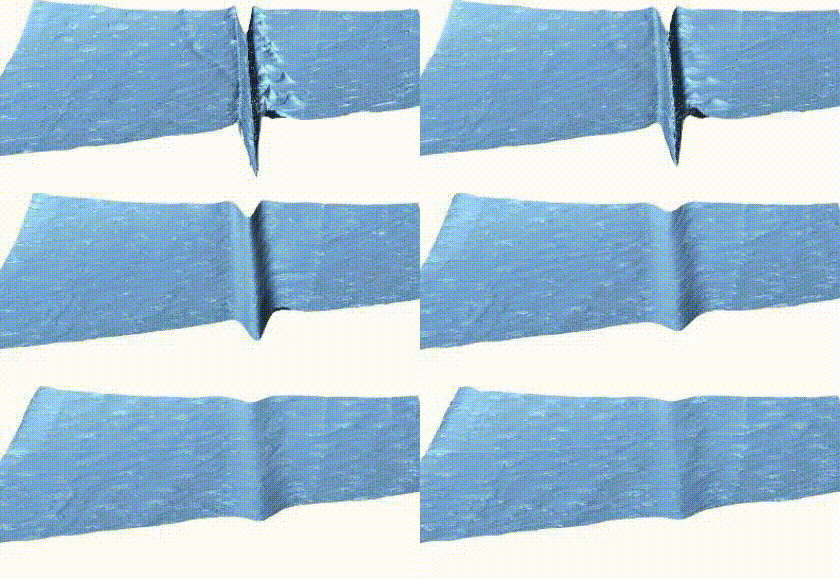
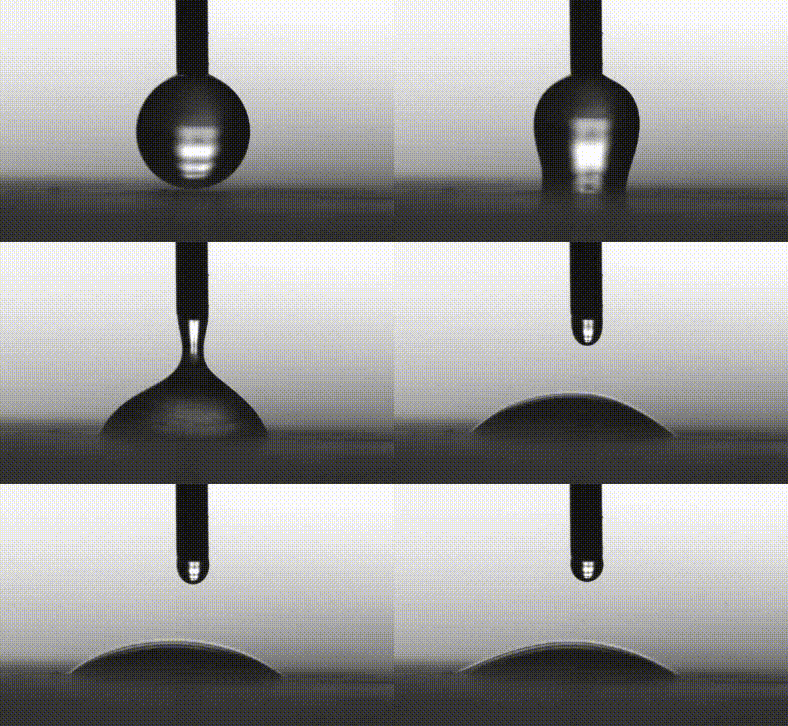
Complementing these macroscopic measurements, we investigate mass transport and wetting at the ice–vapor and ice–water interfaces. Ice sintering and scratch-healing experiments reveal that surface evolution is dominated by sublimation and condensation rather than viscous flow of a quasi-liquid layer [4]: molecules detach into the vapor and re-condense, driven by curvature differences. Partial-wetting measurements of water droplets on ice close to the melting point show finite contact angles and pinning, inconsistent with a continuous pre-melted liquid film covering the surface [5]. These insights into surface transport and wetting underpin our broader efforts to explain freezing damage in porous media, morphological instabilities in icicle growth [6-8], and the microscopic origins of ice friction .
References
[1] Demmenie, Menno, Stefan Kooij, and Daniel Bonn. “Three-dimensional printing of ice structures via evaporative cooling in vacuum.” Proceedings of the National Academy of Sciences 123.36 (2026): e2608173123.
[2] Liefferink, Rinse W., et al. “Friction on ice: How temperature, pressure, and speed control the slipperiness of ice.” Physical Review X 11.1 (2021): 011025.
[3] Weber, Bart, et al. “Molecular insight into the slipperiness of ice.” The journal of physical chemistry letters 9.11 (2018): 2838-2842.
[4] Demmenie, Menno, Sander Woutersen, and Daniel Bonn. “Ice Sintering by Sublimation and Condensation.” The journal of physical chemistry letters 16.8 (2025): 2104-2109.
[5] Demmenie, Menno, et al. “Partial wetting of water on ice.” Physical Review Fluids 10.5 (2025): 054002.
[6] Demmenie, Menno, et al. “Growth and form of rippled icicles.” Physical Review Applied 19.2 (2023): 024005.
[7] Le Dizès Castell, Romane, et al. “Frost damage in unsaturated porous media.” Physical Review Applied 20.3 (2023): 034025.
[8] Demmenie, Menno, et al. “Damage due to ice crystallization.” Scientific Reports 15.1 (2025): 2179.