
Are you a highly motivated physics graduate with a strong interest in soft matter, active matter, and statistical mechanics? We are looking for an ambitious PhD candidate to join an interdisciplinary research project that combines precision experiments on living systems with coarse-grained simulations to uncover the mechanics of active, polymer-like/filamentous matter.
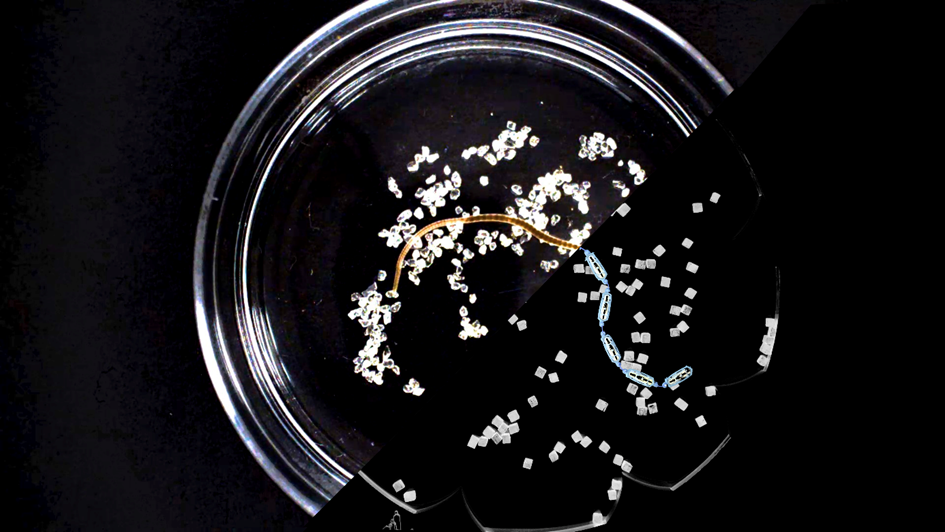
You will join an interdisciplinary research project at the frontier of soft matter and active matter physics, investigating how forces emerge, propagate, and organize in active polymer-like systems. As a PhD candidate, you will work on a cutting-edge research programme that combines precision experiments on living systems with coarse-grained simulations, aiming to uncover the mechanical principles underlying collective behavior in active matter.
You will be embedded in the Soft Matter Group at the Institute of Physics (IoP), within a vibrant and collaborative research environment that brings together experimentalists, theorists, and computational physicists. You will receive close supervision, strong technical support, and ample freedom to develop your own scientific ideas within the scope of the project.
Scientific context
A grand challenge in active matter physics is to understand how collective mechanical properties emerge from the interactions of self-driven constituents. While classical models successfully describe point-like active particles (e.g. flocking models), many real active systems, including worms, ants, cytoskeletal networks, and robotic swarms, are composed of elongated, flexible units with internal degrees of freedom. These systems can align, deform, and entangle, giving rise to collective behaviors and mechanical responses that have no equilibrium counterpart.
Recent work has shown that living Tubifex tubifex worms behave as centimeter-scale active polymers: individual worms act as self-propelled filaments, while groups form highly entangled, dynamic aggregates with unusual, activity-dependent mechanical properties. However, the microscopic origins of these collective forces, from single-worm mechanics to pairwise interactions and many-body entanglement, remain largely unexplored.