
The macroscopic properties of ice—ranging from its low friction to its complex growth morphologies—are fundamentally governed by the behavior of its outermost molecular layer. For over a century, the prevailing theory attributed these properties to a “Quasi-Liquid Layer” (QLL), assuming the surface acts as a thin film of meltwater even well below the freezing point. Research at our laboratory challenges this simplified view, providing experimental evidence that the ice surface is not merely “wet,” but is instead governed by rapid diffusive and gaseous transport mechanisms.
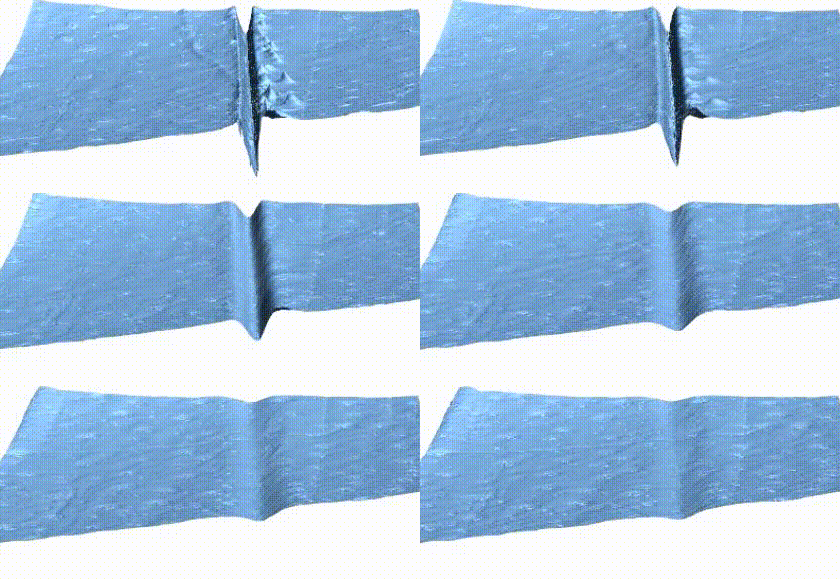
Our work on ice sintering and scratch-healing demonstrates that the surface is highly dynamic, yet distinct from a simple liquid. By observing the merging of ice spheres and the relaxation of surface defects, we established that mass transport is dominated by sublimation and condensation rather than the viscous flow of a liquid film. Surface molecules do not flow; they rapidly detach into the vapor phase and re-condense, driven by differences in surface curvature.
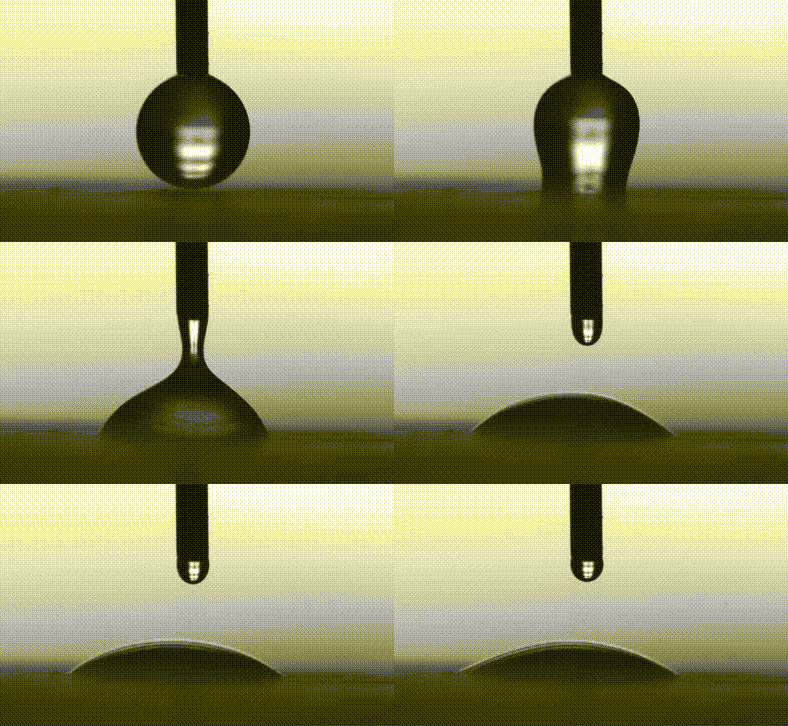
Furthermore, our investigations into the partial wetting of water on ice contradict the existence of a continuous, pre-existing liquid film. We observed that water droplets exhibit finite contact angles on ice surfaces rather than spreading completely. Crucially, these measurements are performed extremely close to the melting temperature. This experimental design ensures that the observed partial wetting is a true thermodynamic state, rather than an artifact of contact line pinning caused by freezing.
Ultimately, we apply these fundamental insights to elucidate the physics of macroscopic phenomena. By characterizing the thermodynamics and transport mechanisms at the interface, we aim to explain the drivers behind freezing damage in porous media, the morphological instabilities of icicle growth, and the origins of ice friction. Our research connects the specific physical behavior of the ice surface to the everyday properties of frozen water.
References
[1] Demmenie, Menno, Sander Woutersen, and Daniel Bonn. “Ice Sintering by Sublimation and Condensation.” The journal of physical chemistry letters 16.8 (2025): 2104-2109..
[2] Demmenie, Menno, et al. “Partial wetting of water on ice.” Physical Review Fluids 10.5 (2025): 054002.
[3] Demmenie, Menno, et al. “Growth and form of rippled icicles.” Physical Review Applied 19.2 (2023): 024005.