
From molecular motors to living tissues, nature is full of active matter: systems that continuously consume energy to move, reorganise and respond to their surroundings. But what if we could engineer materials with similar capabilities?
We investigate how mechanical metamaterials built from active, interacting units can develop collective behaviours such as locomotion, vibration control and adaptive responses. Our goal is to bridge the gap between passive materials and autonomous robots.
Engineering collective behaviour
We use distributed robotic units equipped with sensors and actuators to study how local interactions produce large-scale motion. Combining experiments with continuum mechanics and non-Hermitian physics, we explore phenomena such as directional wave amplification, solitons and spontaneous pattern formation.
By tuning these interactions, we aim to create resilient materials that respond to complex and unpredictable environments without relying on centralised control.
Research highlight: materials that move
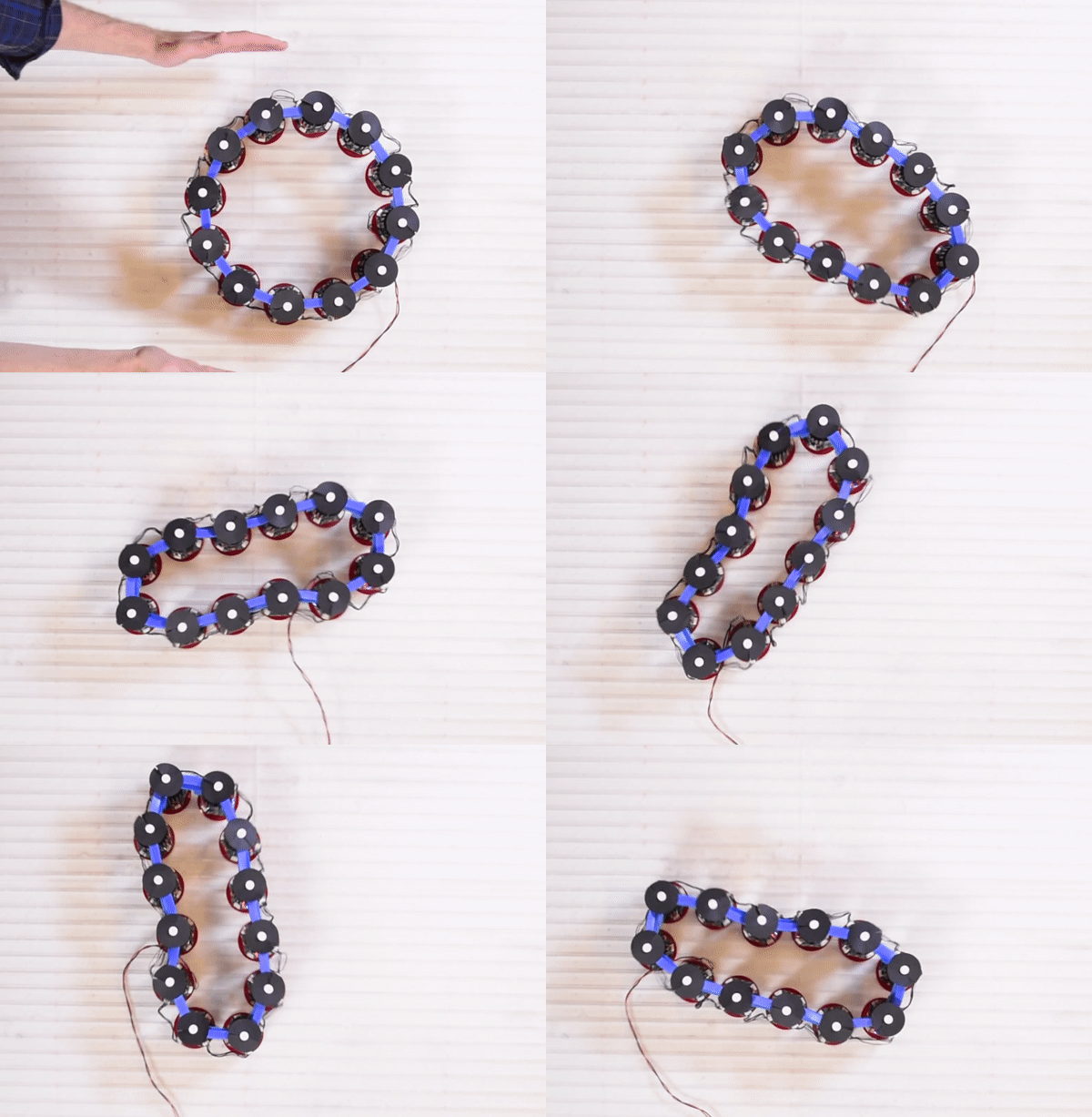
In recent research, we developed active solids capable of rolling and crawling across different terrains. Their movement emerges from interactions between the material’s internal mechanics and its environment, demonstrating how locomotion can arise from distributed mechanical feedback.
FEATURED PUBLICATION · NATURE 2025 Adaptive locomotion of active solids Jonas Veenstra, Colin Scheibner, Martin Brandenbourger, Jack Binysh, Anton Souslov, Vincenzo Vitelli & Corentin Coulais Explore the publication ↗Supervisor: Corentin Coulais
Research team: Jonas Veenstra
Interested in this research? Contact Corentin Coulais ↗