
Navigating more than 100 million possible hydration reactions
Salt hydrates have great potential for sustainable energy applications such as harnessing solar energy or utilising industrial waste heat. As solid salt materials they can store large amounts of heat and release it again later. Their operating principle of thermochemical heat storage is based on the thermal effects during uptake and release of water molecules. They are reusable and can be designed to operate at a broad range of temperatures.
Finding the best salt hydrates – stable enough to store the most heat at the desired working temperature – has always been a major challenge. Researchers estimate that there could be more than 100 million possible hydration reactions worth investigating. Only around 6,000 of these possibilities have been described in literature after experimental or computational investigation.
Chemical composition suffices for machine learning method
The Amsterdam team of chemists, physicists and computational scientists set out to apply AI to tackle this huge search problem. It included the collaboration of Dr Alexander Korotkevich and Prof. Noushine Shahidzadeh at the Institute of Physics, Prof. Sander Woutersen at the Van ‘t Hoff Institute for Molecular Sciences and was led by Dr Alberto Pérez de Alba Ortíz of Computational Soft Matter, who holds a position at both the Van ‘t Hoff Institute for Molecular Sciences and the Informatics Institute. The project was supported by the Research Priority Area ‘AI for Sustainable Molecules and Materials’ at the UvA’s Faculty of Science.
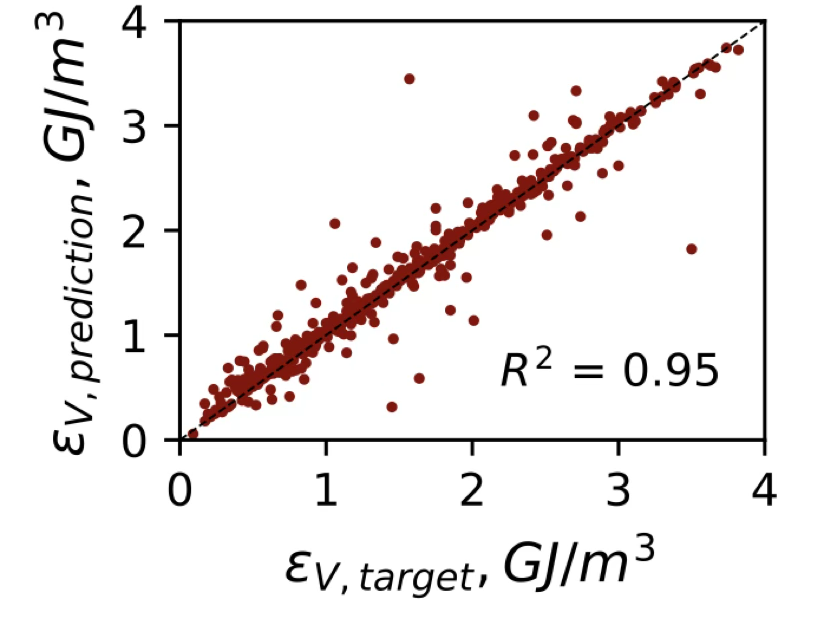
The team developed a machine-learning system that can predict the heat-storage properties of salt hydrates with greater accuracy than existing methods. A crucial feature is that it only requires a material’s chemical composition to predict its thermodynamic properties, while many other approaches require detailed information about its atomic structure. The system thus learns how to predict the relevant properties just based on the types and proportions of the chemical elements present. This makes it very well suited for screening applications where structural information is scarce.
Searching for new salt hydrates
The team used their AI model to search through previously unexplored chemical reactions and identified new candidate salt hydrates that looked particularly promising for heat storage. In collaboration with researchers at Radboud University Nijmegen, they subsequently synthesized some of these materials in the laboratory and measured their heat-storage capacity. Remarkably, the experimental results closely matched the predictions for the successfully produced materials, demonstrating that the machine-learning approach can reliably guide the search for new salt hydrates.
Rather than testing millions of possibilities one by one, scientists can now use artificial intelligence to predict the most promising candidates before turning to laboratory experiments. According to the Amsterdam researchers, this will make the discovery of new heat-storage materials a lot faster and far more efficient. They also expect that the same strategy can be applied to the search for other advanced materials and technologies.
Publication details
Korotkevich, A.A., Shahidzadeh, N., Woutersen, S. et al. Stoichiometry-based machine learning enables discovery of new salt hydration reactions for thermochemical heat storage. Commun Mater (2026). DOI: 10.1038/s43246-026-01200-2.