Emergent correlations, Understanding Reaction Mechanisms from Start to Finish
Speaker: Rik Breebart (UvA)
Abstract:
Self-organization of molecular building blocks into ordered structures is crucial for both living and non- living matter. Artificial Intelligence Mechanistic Molecular Discovery [1] is an autonomous transition path sampling algorithm that uses deep learning to discover the underlying reaction mechanism of such complex self-organizing phenomena. The algorithm uses the outcome of unbiased dynamical trajectories to construct, validate and update the quantitative mechanistic model. With the learned mechanistic model, the sampling of mechanistic trajectories or rare events can be enhanced, completing the cycle. Here, we enhance the method by including all potentially possible configurations in the reweighted path ensemble [2]. We illustrate the novel methodology on simple potentials and a more complex molecular system.
[1] Jung, H. et al. Machine-guided path sampling to discover mechanisms of molecular self-organization. Nature Computational Science 3, 334–345 (2023).
[2] Breebaart, R. S., Lazzeri, G., Covino, R. & Bolhuis, P. G. Understanding Reaction Mechanisms from Start to Finish. Preprint: https://arxiv.org/abs/2507.04052 (2025).
Transport of Active Polymers: Effects of Flexibility and Crowding in Ordered and Disordered Media
Speaker: Rose Di (UvA)
Abstract:
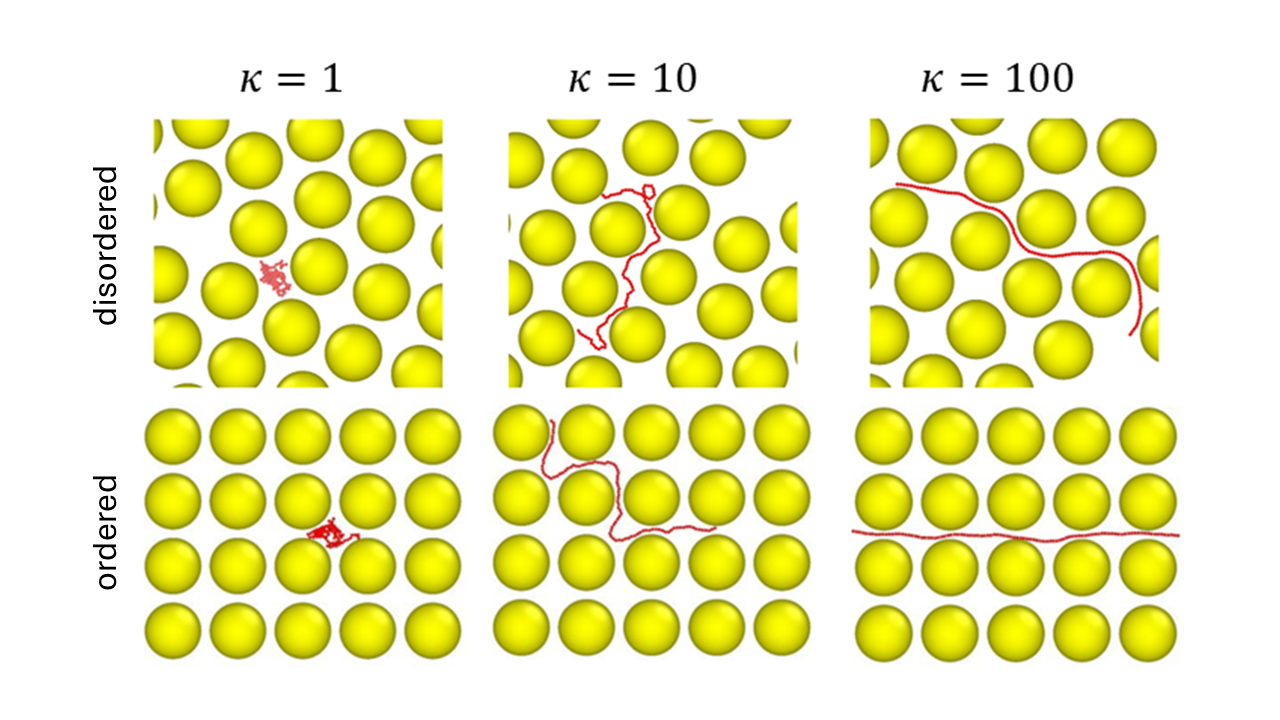
Active polymers navigating crowded environments display transport behaviours that are highly sensitive to their flexibility and to the geometry of their surroundings. Understanding this coupling is essential for interpreting the dynamics of biological filaments (such as worms [1]) and synthetic active chains operating in heterogeneous environments. Extending the work of Fazelzadeh et. al. [2], we use Brownian dynamics simulations of tangentially-driven bead–spring polymers in 2D arrays of fixed obstacles to investigate the conformational and dynamical properties of active polymers at low activity. By systematically varying polymer flexibilities and obstacle packing fractions in both square-lattice and random packings, we construct a long-time diffusion map and identify three distinct flexibility regimes. In the flexible limit, increasing crowding suppresses transport. In an intermediate flexibility range, the translational diffusion exhibits large relative fluctuations and weak enhancement. In the semi-flexible limit, crowding suppresses diffusion monotonically in disordered media. However, in the ordered media, diffusion switches from hindrance at low packing fractions to strong enhancement for high packing fractions, due to directed motion along straight lattice channels. Our results reveal regimes of optimal combinations for flexibility and obstacle density that maximise diffusion for the given system parameters.
[1] R. Sinaasappel, M. Fazelzadeh, T. Hooijschuur, Q. Di, S. Jabbari-Farouji, and A. Deblais, “Locomotion of active polymerlike worms in porous media”, Physical Review Letters, vol. 134, no. 12, p. 128303, 2025.
[2] M. Fazelzadeh, Q. Di, E. Irani, Z. Mokhtari, and S. Jabbari-Farouji, “Active motion of tangentially driven polymers in periodic array of obstacles”, The Journal of Chemical Physics, vol. 159, no. 22, 2023.
This seminar will take place in room C3.158