Investigation of rigidity vs. Connectivity Percolation in Dipolar Active Brownian Particles using computer simulations
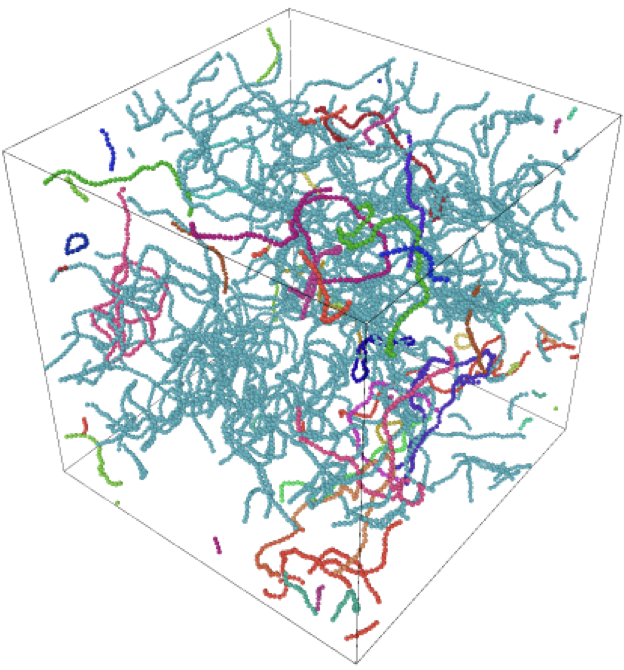
Self-propelled (active) particles with permanent magnetic dipole moments are naturally found in magnetotactic bacteria and can also be engineered in man-made systems, such as magnetic micro-robots. Brownian particles with these permanent dipole moments tend to self-assemble into chain-like structures due to long-range dipole-dipole interactions [1]. When the dipole moments are sufficiently strong, these chains form a disordered network that spans the entire system, ensuring network-wide connectivity—a phenomenon known as connectivity percolation [2]. This connectivity is typically accompanied by structural stability, resulting in a mechanically robust network capable of withstanding deformations, a process referred to as rigidity percolation [3]. However, in systems with self-propelled particles, the activity of these particles competes with dipolar interactions, thereby reducing the average bond lifetime [4]. The relationship between connectivity and rigidity percolation in dipolar particles remains an open question, particularly in active systems due to the dynamic and directional nature of dipolar interactions. It is unclear whether the rigidity transition occurs at the same dipolar coupling strengths or if higher dipolar strengths are required.
In this project, you will explore connectivity and rigidity percolation transitions as functions of dipolar coupling and activity strength using Brownian dynamics simulations and mechanical deformation simulations. Gaining an understanding of the interplay between mechanical stability and network formation is crucial for designing smart materials and controlling collective properties in active matter systems. The project will involve using the high-performance computing molecular dynamics software package LAMMPS and developing codes for data analysis.
References
- Structural properties of the dipolar hard-sphere fluid at low temperatures and densities, Rovigatti, Lorenzo, John Russo, and Francesco Sciortino. " Soft Matter 8.23 (2012).
- Percolation on complex networks: Theory and application, Li, Ming, et al. Physics Reports 907 (2021).
- Rigidity Theory and Applications, Thorpe, Michael F., and Phillip M. Duxbury, eds.. Springer Science & Business Media, (1999).
- Active string fluids and gels formed by dipolar active Brownian particles in 3D, M. Kelidou, M. Fazelzadeh, B., Parage, M. van Dijk, T. Hooijschuur, & S. Jabbari-Farouji, particles, The Journal of Chemical Physics 161 (10) (2024).
Contact
Dr. Sara Jabbari-Farouji s.jabbarifarouji@uva.nl at University of Amsterdam. You will be working in interdisciplinary computational soft matter lab.