Investigation of band formation in two-dimensional systems of dipolar active Brownian particles using computer simulations
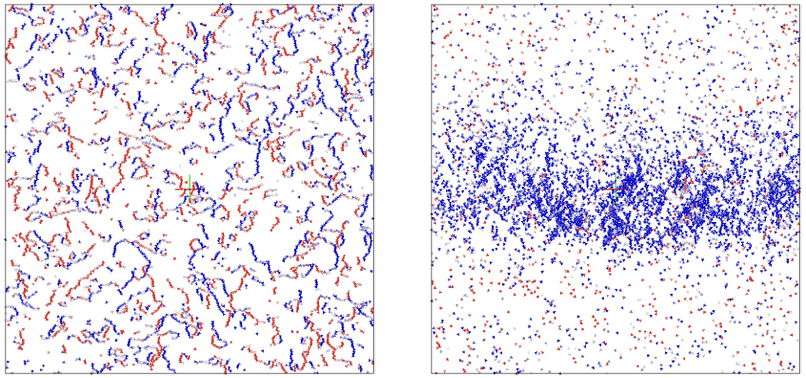
Self-propelled particles with intrinsic dipole moments are naturally found in suspensions of magnetotactic bacteria or can be engineered using Janus colloids [1]. Dipole-dipole interactions, which feature both long-range and anisotropic aspects, are responsible for non-reciprocal torques destabilizing the side-by-side parallel alignment of two dipoles. However, the formation of flocking collective states of motion, where particles move altogether side-by-side, was reported in a simulation investigation [2] on active Brownian dipolar particles (ABP). Interestingly, our recent numerical investigations of two-dimensional (2D) dipolar ABPs have further shown the formation of bands (see figure above) when the self-propulsion velocity exceeds a certain threshold. The formation dynamics and stability of such structures remain unclear, as purely dipolar interactions would, a priori, destabilize the horizontal alignment of dipoles. Additionally, finite-size effects in the simulated systems are believed to play an important role.
In this project, you will perform Brownian dynamics simulations of 2D dipolar active Brownian particles to explore their transitions toward collective states of motion, seeking to understand the interplay between self-propulsion and dipolar interactions in the process of band formation. Comprehending the structure and dynamics of self-propelled dipolar particles is crucial for numerous innovations, such as designing smart active materials or for targeted drug-delivery applications in biomedicine. The project will involve using the high-performance computational molecular dynamics software LAMMPS and developing codes for data analysis.
References
- L. Baraban, D. Makarov, R. Streubel, I. Mönch, D. Grimm, S. Sanchez, and O.G. Schmidt. ACS Nano, 6(4):3383–3389, 2012.
- G.-J. Liao, C.K. Hall, and S.H.L. Klapp. Soft Matter, 16:2208–2223, 2020.
Contact
Dr. Sara Jabbari-Farouji s.jabbarifarouji@uva.nl at University of Amsterdam. You will be working in interdisciplinary computational soft matter lab.