We investigate the understanding and control of resonant light-matter interactions in two-dimensional quantum materials.
Our goal is to study the fundamental physics that governs the optical properties of these quantum materials, and leverage their highly tunable 2D nature to realize dynamic nanophotonic devices. By combining optically-resonant metallic and semiconductor nanostructures with exciton resonances in 2D semiconductors, we actively control light emission, scattering, and absorption in nanoscale devices and optical coatings. Our main experimental techniques include nanofabrication, light scattering experiments, confocal microscopy/spectroscopy (incl. Raman and photoluminescence measurements), photocurrent mapping spectroscopy, and low-temperature microscopy.
Besides developing fundamental understanding, we demonstrate applications of novel physical concepts in optical sensors, tunable light sources, photovoltaics, optical coatings, and augmented/virtual reality.
Contact Dr. Jorik van de Groep, j.vandegroep@uva.nl, group website
Atomically thin optics
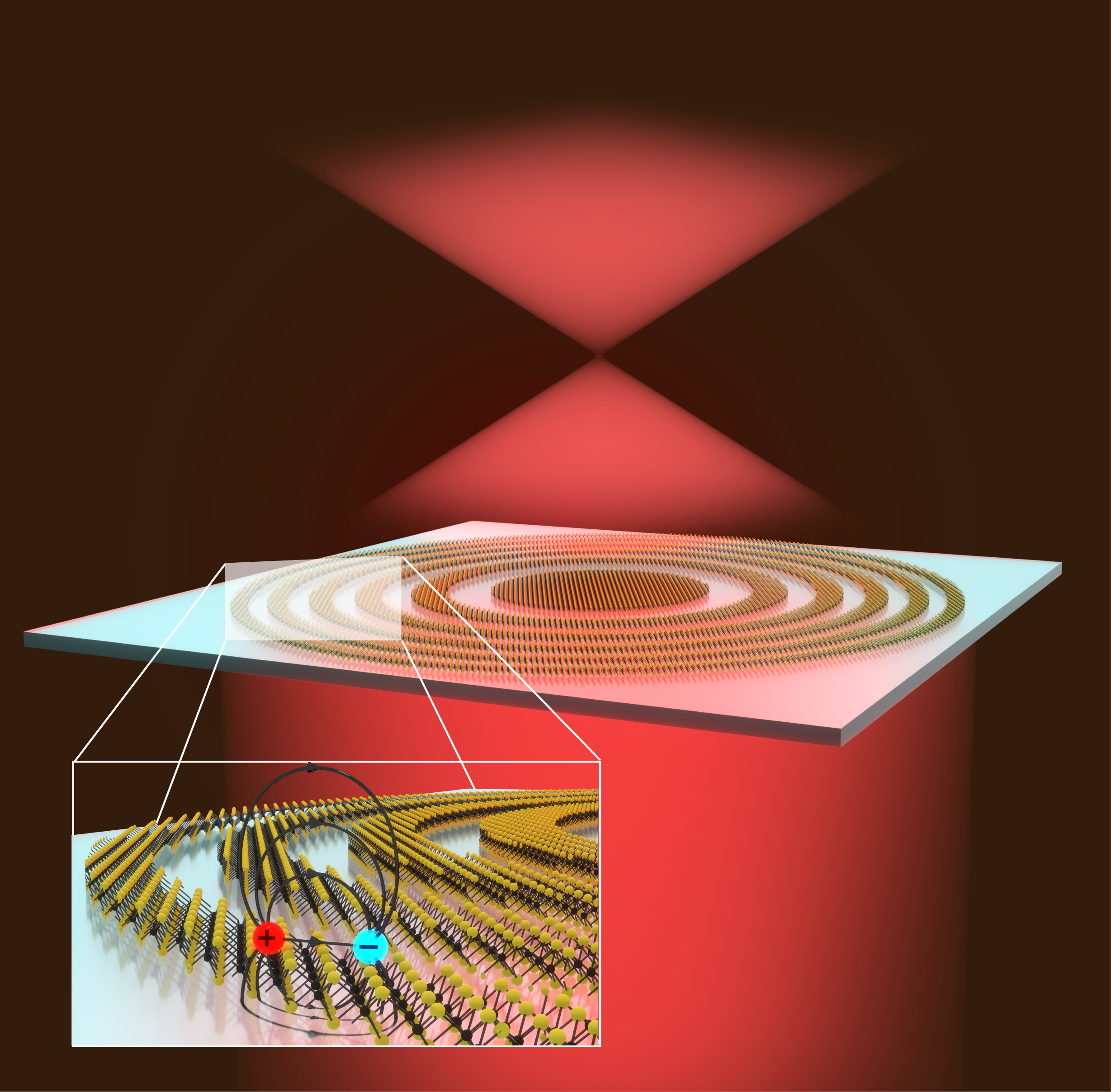
Monolayer 2D semiconductors exhibit a remarkably strong light-matter interaction which is rooted in quantum effects in the material. By nanopatterning large area monolayers we further engineer their light scattering, which turns these sheets into optical elements that are just one layer of atoms thick. Using this, we realize the thinnest lens on earth, redirect light to propagate along the layer, and steer it in arbitrary directions. Combining experiments, simulations and theory, we study the underlying light-matter interactions and material physics to explore the fundamental limits of light manipulation with atomically thin optics.
Tunable metasurfaces
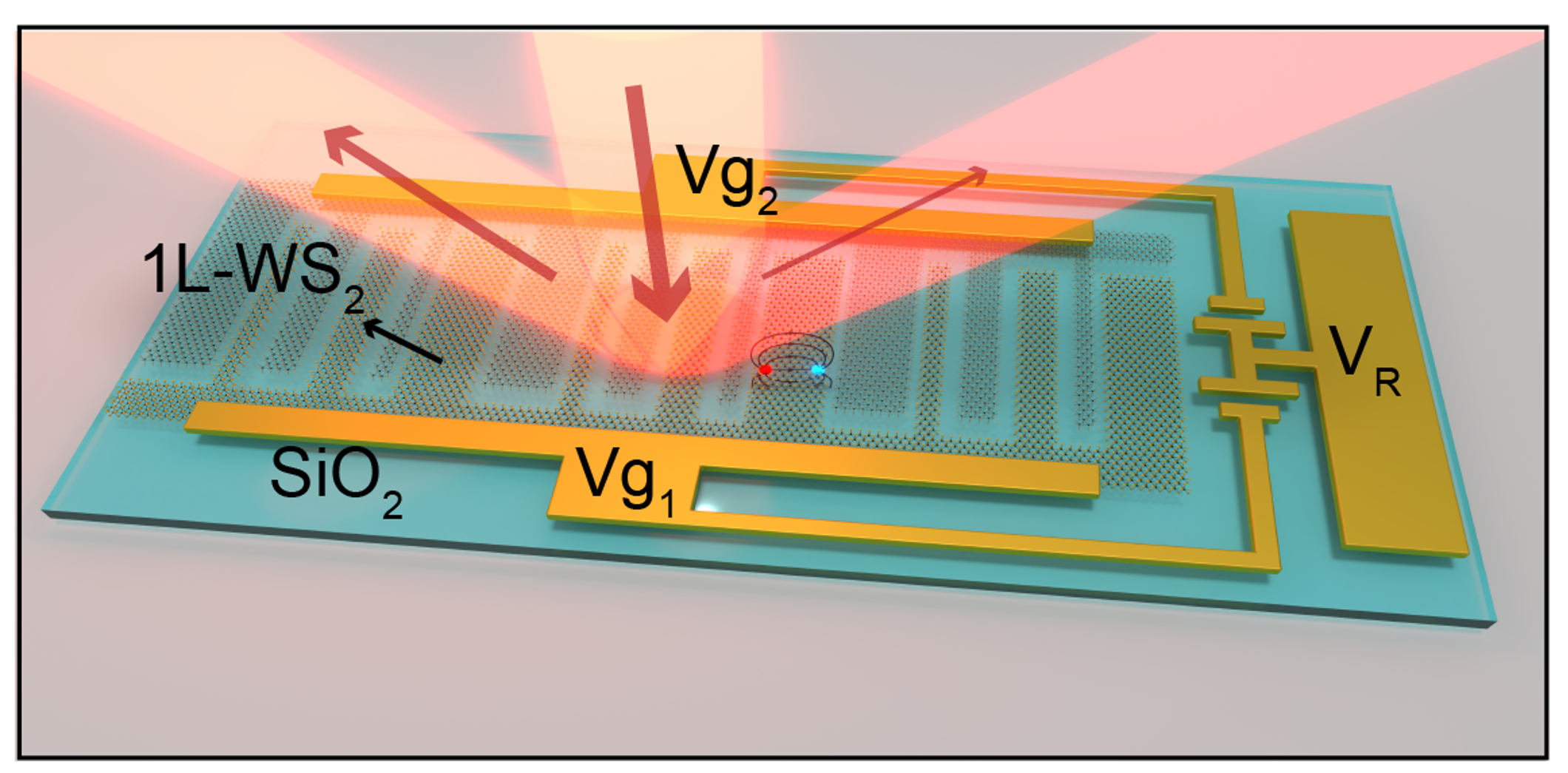
Capitalizing on the strong sensitivity of excitons to electrical signals, we investigate how light can be controlled dynamically in microscale optoelectronic devices. By local injection of charges into the 2D material the resonant light scattering by excitons can be suppressed, providing an active tuning knob for the light-matter interaction. We combine this unique electrical tunability with the high efficiencies of dielectric metasurfaces (which are nanopatterned optical coatings) to develop active metasurfaces, where the optical function is dynamically altered for applications such as tunable lensing, beam steering, filtering, and modulation.
Mechano-optical metasurfaces
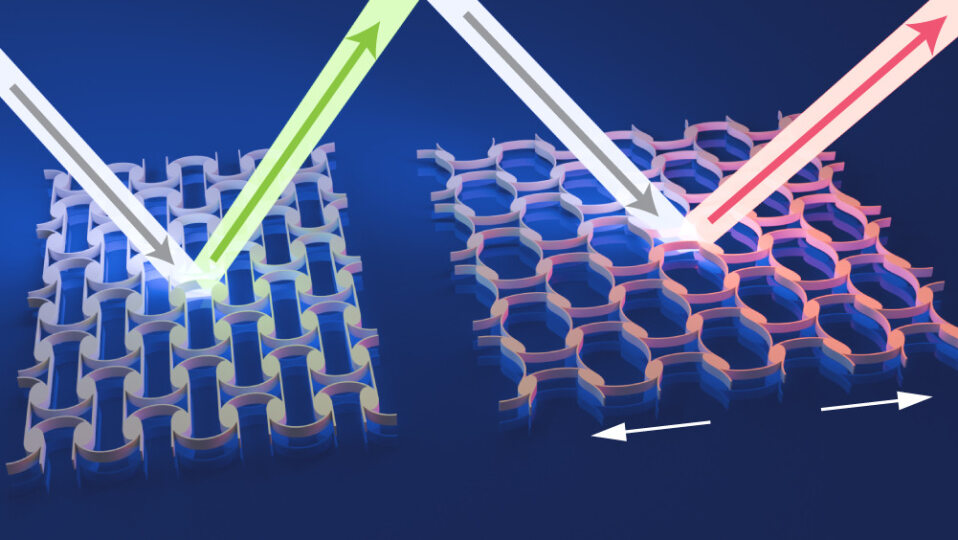
We explore how controlled mechanical motion in metamaterials can be leveraged to achieve large mechanically induced tunabilities in optical metasurfaces. The optical response of a metasurface is very sensitive to the relative spacing and rotation of the nanostructures that scatter the light. Using internal rotations and cleverly placed cuts in a thin substrate, the strain of such mechanical metamaterials can dramatically exceed that of conventional materials, enabling very large displacements of the optically resonant nanoparticles. By combining the optical and mechanical functionalities in one single design, these multifunctional materials offer new ways to dynamically control light.