What determines the properties of matter, like its color? Textbooks will tell you that these properties are due the interactions among and between electrons and phonons, and that photons play no role.
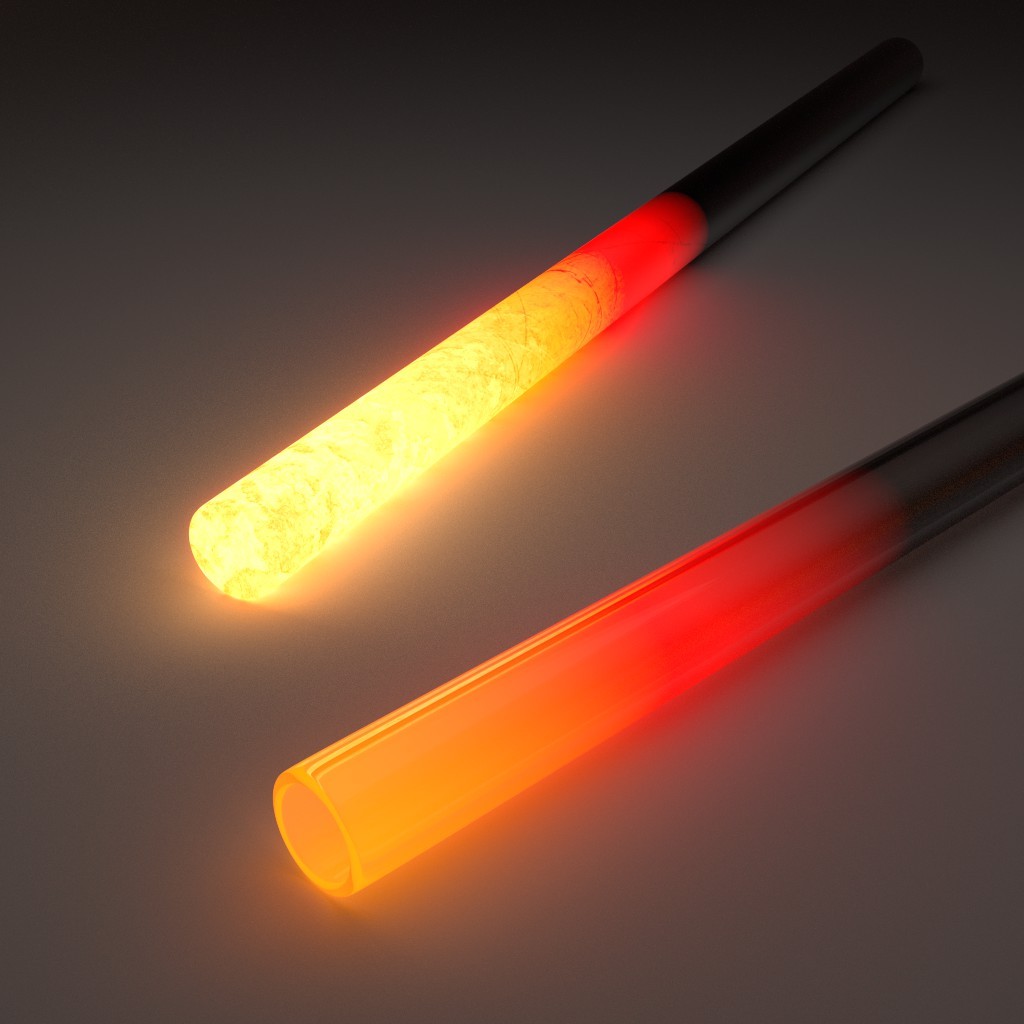
We are here to show that light in matter… matters. By structuring the material using nanophotonic engineering, light can play a dominant role in many material properties! This is well-known for the color: strong coupling between a material transition and an optical resonance results in a dramatically altered absorption spectrum. In the LightMatters group we are extending this light-matter paradigm far beyond the color of a material: to the way hot materials glow (as shown on the left), to many other properties.
Reach out to learn more if you’re interested!
e-mail: s.mann at uva dot nl
web: www.mannlab.nl
Thermal radiation
Research on thermal radiation has advanced from viewing heat emission as an intrinsic material property to treating it as a quantity that can be precisely engineered. Recent work in this area focuses on controlling the spectral, angular, and polarization characteristics of thermally emitted light through nanostructuring and metamaterial design. By combining local resonant responses with nonlocal electromagnetic effects in carefully designed metasurfaces, it becomes possible to sculpt thermal emission beyond the constraints of conventional blackbody behavior.
A central theme is the refinement and extension of Kirchhoff’s law of thermal radiation, particularly in systems that exhibit nonreciprocity or temporal modulation. These studies clarify when and how classical reciprocity-based limits apply, and identify regimes in which emission and absorption can be independently tailored. The resulting theoretical and experimental frameworks enable selective emitters, directional radiators, and dynamically tunable thermal sources, with applications spanning infrared spectroscopy, thermophotovoltaics, radiative cooling, and advanced energy conversion technologies.